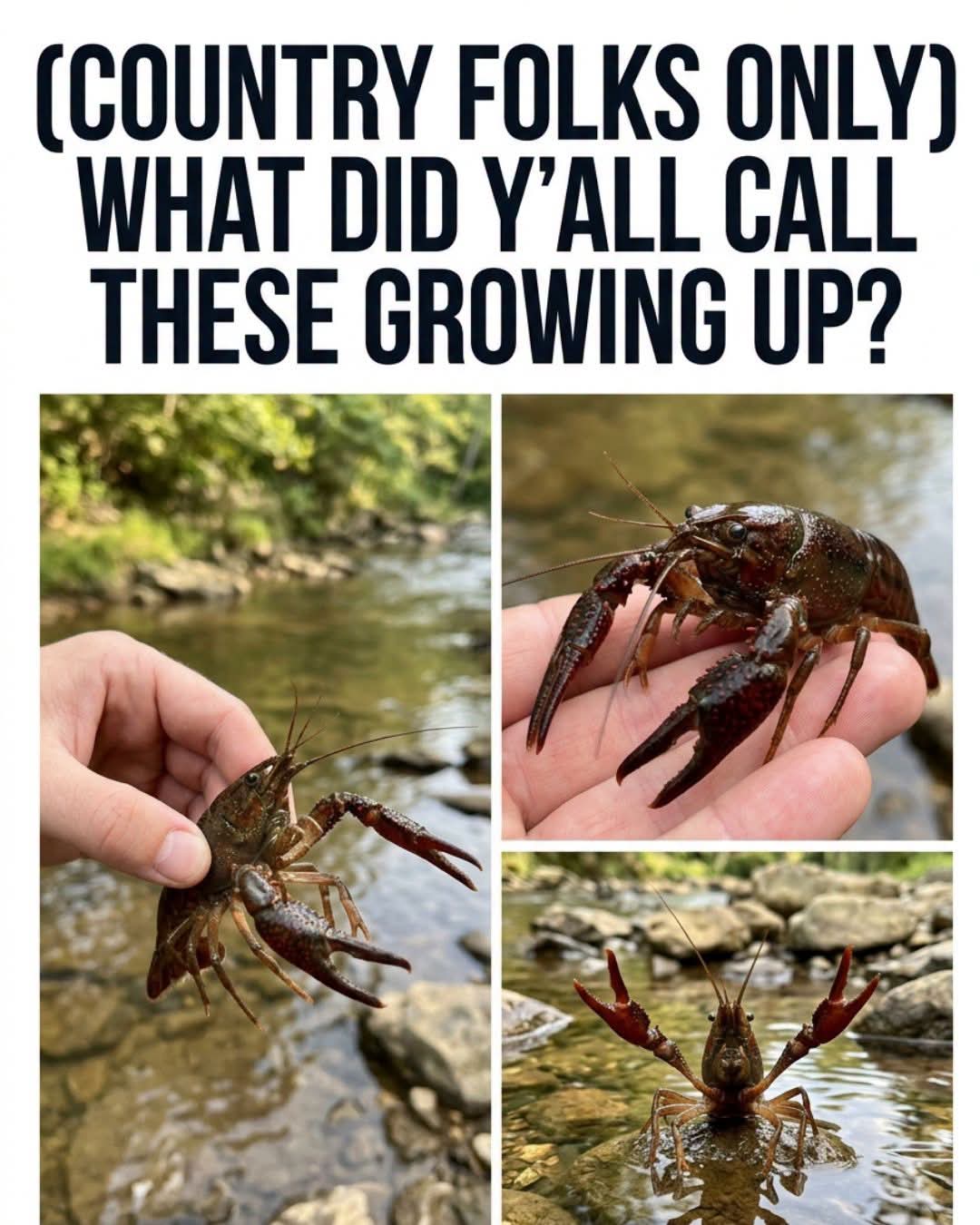
🦞
If you grew up anywhere near a creek, stream, pond, or shallow river, there’s a good chance you remember these little freshwater creatures.
You might have called them crawfish.
Or maybe crawdads.
Perhaps they were crayfish, mudbugs, crawdaddies, or even something completely different.
And if someone from another part of the country used a different name, you may have thought they were the ones saying it wrong. 😂
But here’s the funny part: all of those names can refer to the same type of freshwater crustacean. The name people use is strongly influenced by where they live and the local dialect. (Wikipédia)
So let’s take a nostalgic trip back to those creek-side days.
🦞 What Exactly Are They?
Crayfish are freshwater crustaceans that look like miniature lobsters.
They’re related to lobsters, crabs, and shrimp, but they’re adapted to freshwater environments. Depending on the species, they can live in streams, creeks, rivers, ponds, swamps, ditches, and other freshwater habitats. (Wikipédia)
They have:
- A hard outer shell
- Two prominent claws
- Several walking legs
- Long antennae
- A segmented tail
- Feather-like gills for breathing
And those claws?
They definitely made catching them a little more exciting when you were a kid. 😆
🌎 Crawfish, Crawdads, or Crayfish?
Here’s where things get interesting.
There isn’t one universally used American name.
In much of the Southern United States, people commonly say crawfish.
In parts of the northern United States, crayfish is more common.
And crawdad has traditionally been especially common in portions of the central and western United States.
Mudbug is another familiar Southern nickname, particularly associated with Louisiana and parts of Texas. (KPRC)
The boundaries aren’t exact, though. People move, families use different terminology, and regional dialects overlap.
So if your family called them crawdads while your neighbor called them crawfish, neither necessarily had the “wrong” name.
🏞️ Catching Them in the Creek
For generations, children have discovered that shallow freshwater habitats can be surprisingly entertaining places to explore.
You’d turn over rocks.
Look into little holes along the creek bank.
Watch carefully between submerged stones.
And then suddenly—
THERE IT WAS!
A little crayfish scurrying sideways through the water.
The excitement wasn’t necessarily about eating them.
Sometimes it was simply about catching one.
You’d carefully reach down, grab it, and immediately learn that those claws deserved some respect.
Then came the most important part:
Showing everybody else what you caught.
🦞 They Aren’t Fish at All
Despite the name crayfish or crawfish, these animals aren’t fish.
They’re crustaceans.
That puts them in the same broad group as other familiar animals such as crabs, shrimp, and lobsters.
They also grow by periodically shedding their hard outer shell in a process called molting. (Biology Insights)
So the next time someone calls them “fish,” you can tell them:
“Technically… they’re little freshwater crustaceans.”
Of course, if your family has always called them crawdads, you’re probably going to keep calling them crawdads anyway. 😂
🌿 Why Are Crayfish Important?
They’re not just something fun to catch.
Crayfish play important roles in freshwater ecosystems.
They eat a mixture of plant material, animals, and decaying organic matter, and they can also become food for larger animals. (Wikipédia)
They are part of the food web in many streams and rivers, providing food for fish, birds, reptiles, amphibians, and mammals.
Their burrowing and feeding activities can also influence the environments around them.
Some crayfish species are particularly sensitive to changes in water quality, making them useful indicators of freshwater ecosystem conditions. (National Geographic)
🍽️ And Yes… People Eat Them!
For many people, crawfish aren’t just childhood creek creatures.
They’re food.
Crawfish are particularly important in Southern U.S. cuisine, where they’re commonly prepared in crawfish boils.
A traditional boil can include crawfish alongside:
- Corn on the cob
- Potatoes
- Sausage
- Garlic
- Onions
- Seasonings
- Lemons
Everything gets cooked together and served as a communal meal.
Crawfish farming and production are also major industries, particularly in Louisiana and other Southern states. Texas A&M’s crawfish production manual notes the importance of crawfish culture and identifies red swamp and white river crawfish among the major aquaculture species. (RWFM Extension)
🧒 The Childhood Memories
For many people, though, the strongest memory isn’t a crawfish boil.
It’s a creek.
It’s muddy shoes.
It’s wet hands.
It’s turning over rocks.
It’s somebody yelling:
“I GOT ONE!”
And then everyone coming running.
Maybe you kept them in a bucket for a little while.
Maybe you raced them.
Maybe you released them right back into the creek.
Maybe you got pinched and immediately decided you were finished with crawdad hunting for the day. 😂
And maybe you never actually caught one because those little creatures were much faster than they looked.
🗺️ A Word That Can Tell You Where Someone Grew Up
One of the fun things about regional vocabulary is that ordinary words can reveal where someone’s family came from.
Ask someone what they call this creature and you might hear:
“Crawfish.”
“Crawdads.”
“Crayfish.”
“Mudbugs.”
And suddenly you’re having an entirely different conversation about childhood, geography, grandparents, fishing trips, summer vacations, and local traditions.
The variation is well documented: regional terminology for these freshwater crustaceans differs considerably across the United States. (Biloxi Sun Herald)
🦞 What Did YOU Call Them?
Now comes the important question.
Forget what the dictionary says.
Forget what your science teacher called them.
What did YOUR family call them?
🦞 Crawfish
🦞 Crawdads
🦞 Crayfish
🦞 Mudbugs
🦞 Crawdaddies
🦞 Something else entirely!
And here’s the real test:
Did you ever catch one in a creek when you were growing up?
Tell us what you called them and what state or region you grew up in. 👇
Because there’s a good chance the comments are about to turn into one giant “that’s NOT what we called them!” debate. 😂
❤️ Some Childhood Memories Never Get Old
Long before smartphones and screens occupied every spare minute, a shallow creek could provide an entire afternoon of entertainment.
A few rocks, some muddy water, and a handful of crawdads were enough.
You didn’t need much.
You just needed curiosity, a little patience, and maybe a willingness to risk getting pinched.
So… what did y’all call these growing up? 🦞👇
Note: “crawfish,” “crayfish,” “crawdad,” and “mudbug” are regional names that can refer to freshwater crayfish; exact species vary by location. (San Antonio River Authority)
