🍟 Let’s Settle the Sauce Debate!
There are few food debates more delicious than this one: when you have a bowl of fries and a favorite dipping sauce, which shape gives you the perfect bite?
Ketchup, ranch, cheese sauce, garlic mayo, barbecue sauce, honey mustard—whatever your favorite dip happens to be, the shape of the potato can make a surprising difference.
Some fries are smooth and simple. Others have ridges, curls, holes, or pockets that seem almost designed to grab onto sauce.
And then there are tater tots, which aren’t technically French fries but absolutely deserve a place at the table. 😋
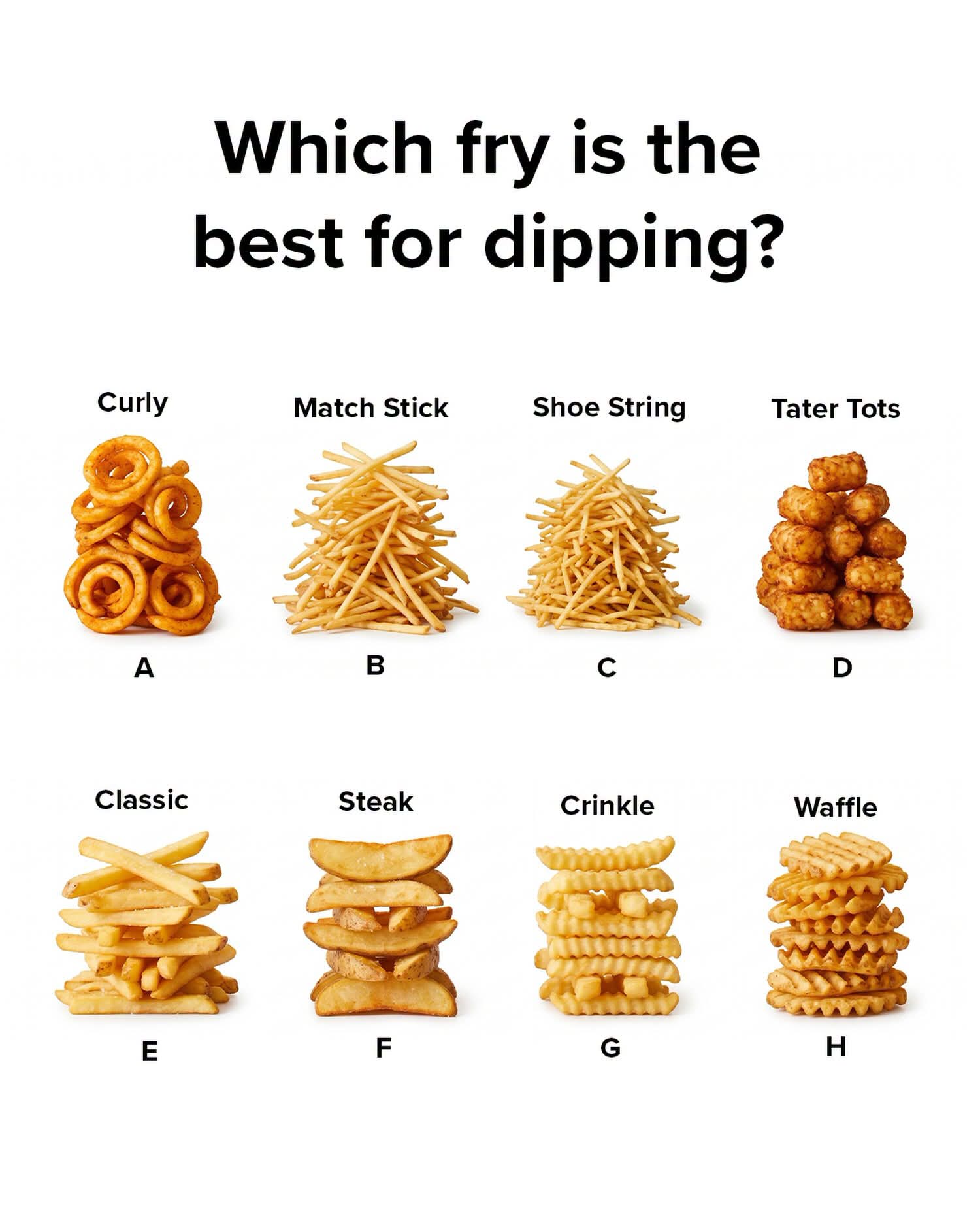
So let’s look at all eight choices in the picture!
🌀 A — Curly Fries
Curly fries bring plenty of personality to the plate.
Their spiral shape creates curves and twists that can catch seasoning and sauce. Depending on how they’re prepared, they can also have a seasoned coating that adds another layer of flavor.
The downside? Some of the tighter curls can make it difficult to get a generous amount of sauce into the center.
But when you find one of those long, perfect curls and drag it through a pool of ranch or cheese sauce?
That’s a serious dipping moment. 😂
🥢 B — Match Stick Fries
Matchstick fries are extremely thin, giving them a much higher proportion of crispy exterior to soft potato center.
They’re fantastic if crunch is what you’re after.
But when it comes specifically to dipping, their thinness can work against them. A thick sauce can overpower the delicate fry, and you may end up with more sauce than potato.
They’re also more fragile than thicker cuts.
Great for crunch. Questionable for maximum dipping power.
🍟 C — Shoestring Fries
Shoestring fries are another super-thin option, but they’re particularly fun when they’re piled high and crispy.
Because they’re so thin, they can pick up a coating of sauce quickly. They’re especially good for people who like to grab a handful and dip several at once.
The trade-off is that they’re usually more about crispiness than fluffy potato.
If you love a fry that practically shatters when you bite into it, shoestring fries have plenty going for them.
🥔 D — Tater Tots
Okay, technically they’re not French fries.
But we’re not leaving them out. 😆
Tater tots are little potato nuggets with a crisp exterior and a softer interior. Their compact shape makes them naturally easy to pick up and dunk.
And unlike very thin fries, a tot can survive a serious dip.
Ketchup? Absolutely.
Cheese sauce? Definitely.
Ranch? Of course.
Spicy mayo? Now we’re talking.
Tater tots are particularly useful when the sauce is thick because you can practically use the entire tot as a little potato scoop.
🍟 E — Classic Straight-Cut Fries
Sometimes the original doesn’t need much explanation.
Classic straight-cut fries offer a simple combination of crispy edges and a fluffy potato interior when properly cooked. They’re also incredibly versatile.
They’re long enough to dip easily, thick enough to carry sauce, and familiar enough that almost everyone knows exactly what they’re getting.
They’re the all-purpose dipping fry.
Whether it’s ketchup at home, gravy, aioli, ranch, or a burger sauce, the classic straight cut can handle just about anything.
🥩 F — Steak Fries
Steak fries are the big boys of the group.
They’re substantially thicker than shoestring or classic fries, which means there’s plenty of fluffy potato inside.
That thickness also makes them excellent for heavy, rich sauces.
Think:
🧀 Cheese sauce
🥣 Gravy
🌶️ Spicy mayo
🧄 Garlic aioli
🥓 Loaded toppings
Their larger surface and sturdy structure can handle a substantial dip without immediately falling apart. Food Republic likewise notes that the broad surface of steak fries can take on plenty of salt and work well with sauces. (Food Republic)
The trade-off is that they don’t necessarily deliver the same level of crunch as thinner fries.
🌊 G — Crinkle-Cut Fries
Now we’re getting serious about dipping.
Those ridges aren’t just there to make the fries look fun.
The wavy surface creates extra grooves and edges, giving sauce more places to cling. Food-industry guidance specifically highlights crinkle-cut fries for dipping sauces, while food references note that the ridges increase surface area for seasoning and condiments. (Potato Goodness)
Imagine dragging one through a thick cheese sauce.
The sauce gets caught in the valleys.
You get crispy edges.
You get potato.
You get sauce.
That’s exactly what a dipping fry is supposed to do.
🧇 H — Waffle Fries
And then we have the waffle fry.
That distinctive crisscross pattern creates a network of little openings and ridges that can catch sauces, toppings and seasonings.
They’re almost like edible little scoops.
Waffle fries are particularly useful when you want more than a quick dunk. Their lattice structure gives thicker sauces plenty of places to settle, and sources describing the cut specifically point to its sauce- and topping-holding ability. (Food Republic)
Dip one into cheese sauce and you’ll quickly understand why the shape exists.
It’s basically a potato-shaped sauce trap. 😂
🥫 Why Does Fry Shape Matter So Much?
It comes down to a few simple things:
1. Surface area
More ridges, curves and edges can provide more places for sauce to stick.
2. Thickness
Thicker fries can carry heavier sauces without becoming overwhelmed.
3. Texture
Crispy fries provide contrast against creamy or smooth dips.
4. Structure
A sturdy fry can survive repeated dipping better than an extremely thin or fragile one.
5. Sauce thickness
A thin ketchup behaves differently from thick cheese sauce or gravy.
That’s why there isn’t necessarily one universal answer. The best shape can depend on the dip.
🧀 Match the Fry to the Sauce
Want to make your own fry-and-dip tasting board?
Try different combinations:
🍅 Ketchup
Classic straight-cut, curly or crinkle-cut.
🧀 Cheese sauce
Waffle, crinkle-cut or tater tots.
🥛 Ranch
Curly, waffle or classic fries.
🧄 Garlic aioli
Steak fries or shoestring fries.
🌶️ Spicy mayo
Curly fries or waffle fries.
🥣 Gravy
Steak fries or thick straight-cut fries.
🍯 Honey mustard
Crinkle-cut or tater tots.
And if you’re serving several dips at once, putting several shapes on the table turns an ordinary plate of fries into a little potato tasting experience. 😋
🤔 But There’s More to a Good Dipping Fry Than Shape
Even the perfect shape won’t save a soggy fry.
Temperature matters.
So does cooking.
A beautifully ridged fry that’s limp and cold isn’t going to give you the same experience as a hot, crisp one.
That’s why discussions about the “best” fry often come down to more than shape. Texture, seasoning, thickness and preparation all influence how people experience the fry. (The Takeout)
And let’s be honest—sometimes the sauce itself is half the battle.
A mediocre fry with incredible garlic aioli can suddenly become the star of the meal. 😂
🏆 The Ultimate Dipping Question
Looking at the eight choices:
A — Curly 🌀
B — Match Stick 🥢
C — Shoestring 🍟
D — Tater Tots 🥔
E — Classic 🍟
F — Steak 🥩
G — Crinkle 🌊
H — Waffle 🧇
The picture may look like a simple food question, but there’s actually a lot going on. Smooth fries, ridged fries, thin fries and chunky potato bites all interact with sauces differently.
Some people want maximum crunch.
Some want maximum sauce.
Some want the fluffy potato center.
And some people just want a giant pile of curly fries. 😂
🍟 SO, WHAT’S YOUR PICK?
Which one would you choose specifically for dipping?
A, B, C, D, E, F, G or H? 👀🍟
And most importantly… what’s the sauce going in the bowl? 😋
