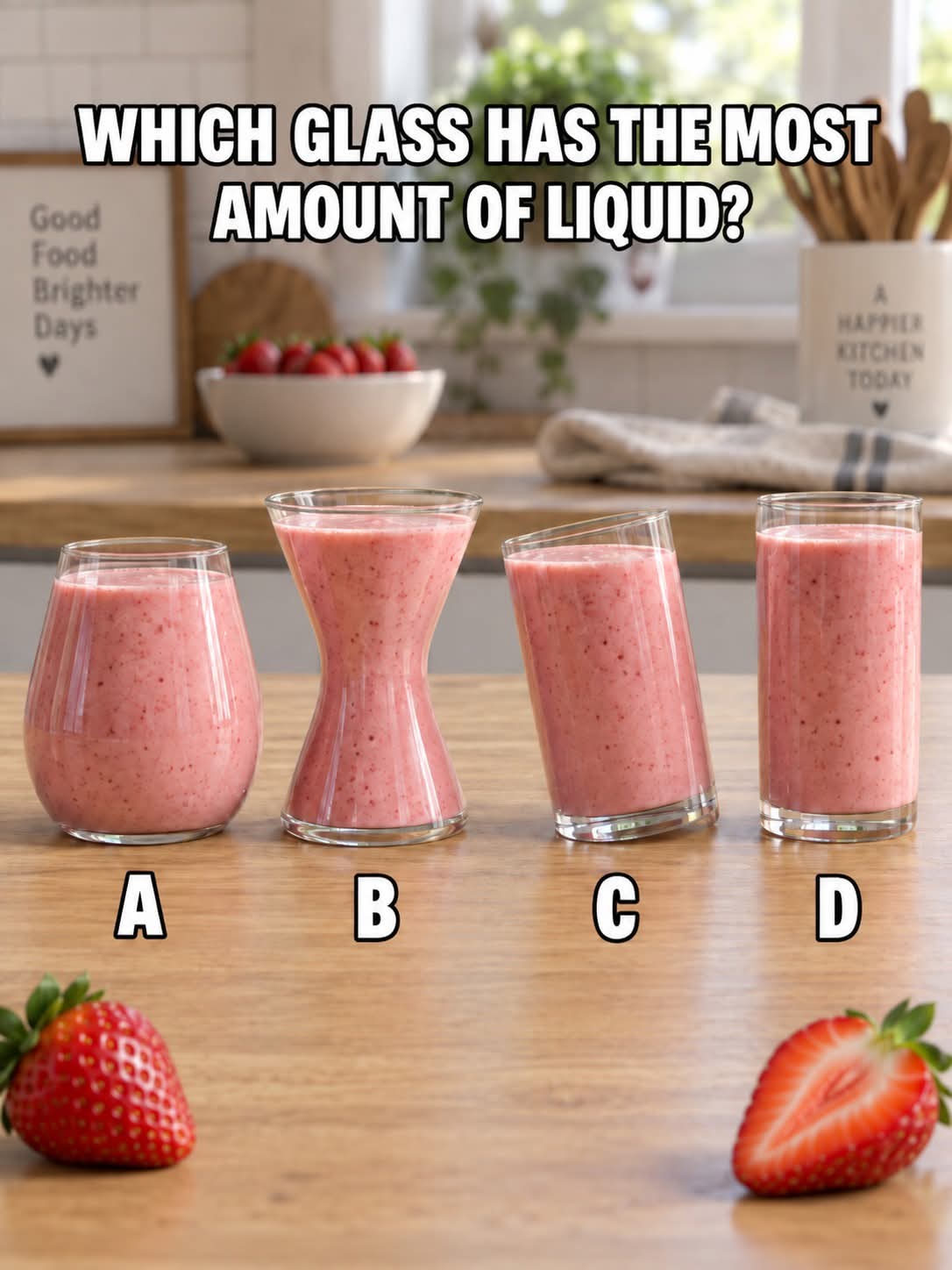
🥛 Which Glass Has the Most Liquid? 🤔
Can You Solve This Tricky Kitchen Puzzle?
At first glance, this looks like an easy question:
Which glass contains the most liquid?
A, B, C, or D? 👀
But don’t choose based only on how high the smoothie reaches. That’s the trick!
When containers have different shapes, the height of the liquid doesn’t necessarily tell you how much liquid is actually inside. A tall, narrow glass can look fuller than a shorter, wider one even when the actual volumes are very different. Research on how people judge liquid volume has found that the shape and height of a glass can strongly influence our perception. (PubMed Central (PMC))
So take another look at the picture before you answer.
🥤 What’s your guess?
A — B — C — or D?
Don’t scroll too quickly… make your choice first! 😄
👀 Why This Puzzle Is Trickier Than It Looks
Our eyes naturally tend to focus on the height of the liquid.
That’s why a tall, slender glass often gives the impression that it contains more than a shorter, wider glass. In reality, volume depends on the entire three-dimensional shape of the container—not simply how high the liquid comes. (PLOS)
Think about pouring exactly the same amount of juice into a tall glass and a short, wide glass. The liquid level will be much higher in the tall glass, even though the amount of juice hasn’t changed at all. Educational resources use this exact demonstration to teach capacity and volume. (Meaningful Maths)
That’s what makes these puzzles so fun!
🥤 Let’s Look at the Four Glasses
🅰️ Glass A
Glass A is relatively wide through much of its body.
Although the smoothie doesn’t reach as high as it does in some of the other glasses, there’s a substantial amount of liquid spread across its wider interior.
Don’t automatically eliminate A!
🅱️ Glass B
Now look at B.
This glass has a dramatically different shape. It is narrow around the middle and wider toward both the top and bottom.
That makes judging its volume simply by looking at the liquid level particularly difficult.
The fact that the smoothie reaches relatively high doesn’t automatically mean it contains the most.
🅲 Glass C
C is tall and fairly narrow, and the glass is tilted slightly in the picture.
That can make it especially deceptive.
Tall, narrow containers commonly make people perceive a quantity of liquid as greater than it actually is. This is sometimes called the elongation effect. (PubMed Central (PMC))
🅳 Glass D
D is tall and relatively straight-sided.
Because the liquid reaches quite high, many people will immediately choose D.
And that’s exactly what makes the puzzle interesting!
A high liquid level doesn’t necessarily mean the greatest volume. The width of the container and how that width changes from bottom to top matter too.
🧠 The Big Lesson: Height Isn’t Volume
Here’s the important takeaway:
You can’t accurately determine the amount of liquid in differently shaped glasses just by comparing the liquid heights.
To calculate volume precisely, you’d need measurements of the containers—their dimensions and shape. Mathematics problems involving glasses typically require information such as radius, diameter, height, or the geometry of the container. (Illustrative Mathematics)
For example, a conical glass behaves very differently from a cylindrical one. In a cone, the cross-sectional area gets larger as you move upward, so the amount of liquid added for each additional centimeter of height changes. (Mind Your Decisions)
That’s why our eyes can be fooled so easily.
🏆 So What’s the Answer?
For this particular picture, the intended answer is D. 🥛
But here’s an important catch for a genuinely accurate puzzle:
The image alone doesn’t provide enough measurements to mathematically prove which glass contains the greatest volume. The glasses are different shapes and appear to be illustrations rather than precisely measured containers.
So D is the intended visual-puzzle answer, rather than a mathematically verified volume comparison.
And that’s actually part of the fun!
🤯 Did You Get It Right?
These puzzles are a great reminder that what looks like more isn’t always more.
Our brains naturally use height as a shortcut when estimating liquid quantities, but the shape of the container can dramatically change our perception. Studies have demonstrated that people can systematically misjudge volumes in differently shaped glasses. (PubMed Central (PMC))
So next time you’re pouring a smoothie, juice, milk, or iced coffee, remember:
Don’t judge the drink by its height! 😂
🥛 NOW IT’S YOUR TURN!
Which one did YOU choose before reading the answer?
🔵 A
🟢 B
🟡 C
🔴 D
Did you get it right, or did this one fool you? 👀👇
Share this with someone and see if they can solve it without changing their answer! 😄
