🔥 ? Let’s Settle the Debate!
We’ve all done it.
You put something on the stove, step away for “just a minute,” and suddenly…
Oh no. 😳🔥
The steak is blackened.
The eggs are rubbery.
The fries are practically charcoal.
The chicken is dry.
The broccoli has turned into something that belongs in a campfire.
The question is:
Which one tastes the WORST when overcooked? 👀
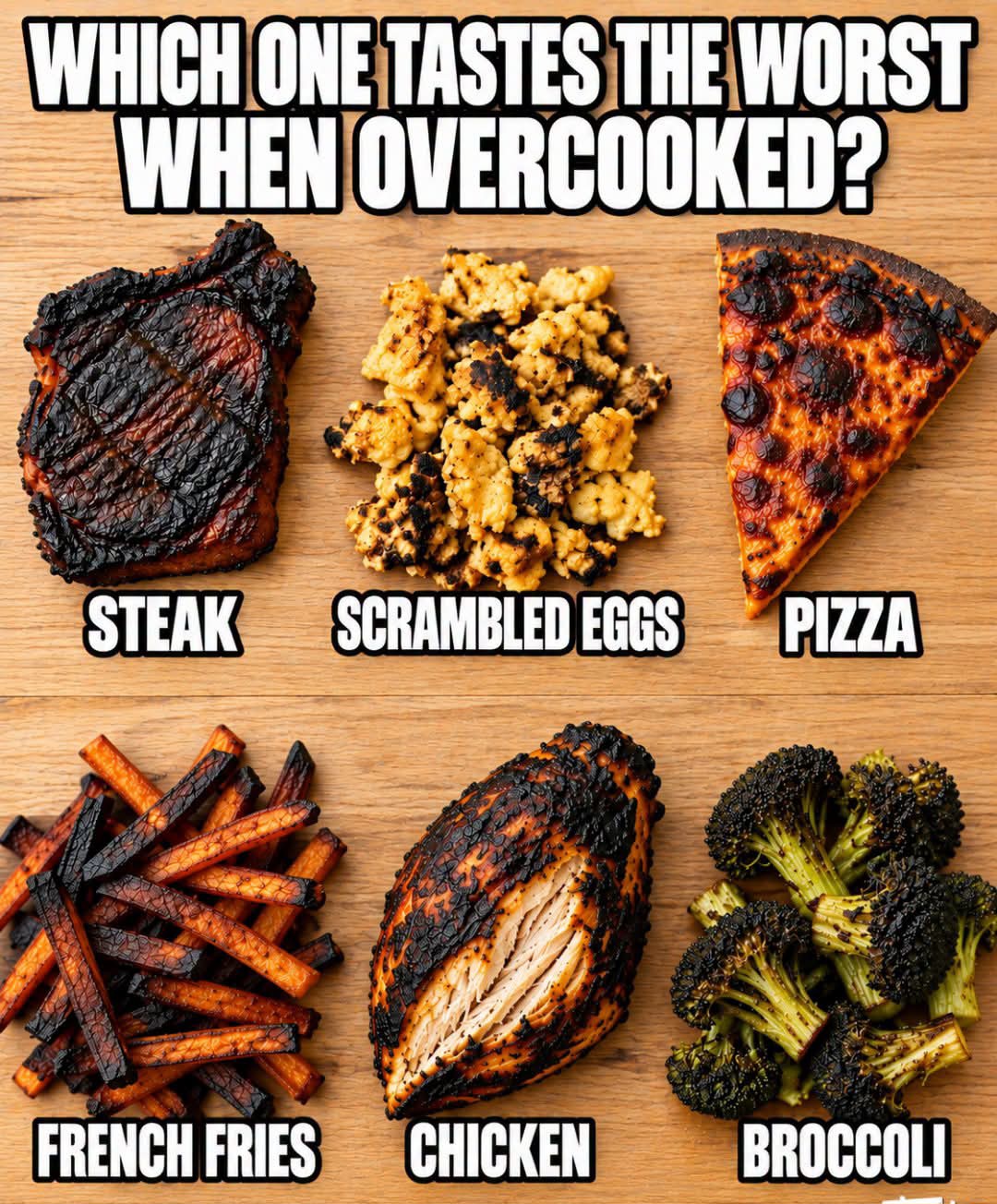
This picture gives us six contenders:
🥩 Steak
🍳 Scrambled eggs
🍕 Pizza
🍟 French fries
🍗 Chicken
🥦 Broccoli
And every one of them has a different way of going wrong.
🥩 Steak — From Juicy to Tough
A good steak is all about texture and juiciness.
When it’s cooked appropriately, you can get a flavorful browned exterior with a tender interior. But keep cooking it far beyond your preferred doneness and you can lose a lot of that tenderness and moisture.
The steak pictured here looks like it has gone way past the point of no return. 😂
The outside is heavily charred, while the interior looks dry.
Of course, there is a difference between intentional browning or charring and simply burning a steak.
For food safety, USDA recommends that whole cuts of beef, pork, lamb and veal reach at least 145°F (62.8°C) and rest for at least three minutes. A thermometer is much more reliable than judging safety by appearance. (FSIS)
The real tragedy?
You paid good money for that steak.
And now you’re chewing it like beef-flavored leather. 😭
🍳 Scrambled Eggs — The Rubber Problem
Few foods change texture as dramatically as scrambled eggs.
Soft, creamy scrambled eggs can be incredibly delicate.
But leave them over heat too long and they become:
Dry. Firm. Rubbery.
Instead of soft curds, you end up with something that looks like it has been sitting under a heat lamp since breakfast.
There’s also an interesting safety point here: USDA recommends cooking eggs to 160°F (71°C). Scrambled eggs cooked at excessively high temperatures or held too long can even develop a greenish cast, which USDA notes is safe to eat but is a classic sign that the eggs have been overcooked. (FSIS)
🍳 The goal?
Cook them until they’re set and still pleasantly moist—not until every last drop of moisture has disappeared.
🍕 Pizza — When the Crust Becomes a Weapon
Pizza can handle plenty of heat.
In fact, high heat is part of what gives pizza its appealing crust and browned toppings.
But there’s a point where golden brown becomes burned.
The pizza in the image has crossed that line. 😂
The cheese is heavily blackened, the crust is charred, and those toppings aren’t exactly looking enthusiastic about dinner.
There’s a difference between a little char—which some people love—and completely burnt food.
🍕 The perfect pizza balance:
Crispy edges ✅
Melted cheese ✅
Browned toppings ✅
Charred beyond recognition ❌
Some people will happily defend a little blackened crust, though.
And that’s where the debate gets interesting.
🍟 French Fries — Crispy vs. Burnt
This one might be controversial.
A properly cooked fry should generally have a contrast between the exterior and interior:
crispy outside + tender inside.
Overcook it, and the inside loses moisture while the outside becomes hard, dark, and bitter.
Eventually, you’re no longer eating a fluffy potato center.
You’re eating a tiny edible stick of charcoal. 😂
🍟 But here’s the debate:
Some people actually prefer fries very crispy.
So where does crispy end and burnt begin?
That’s completely subjective.
A dark, crunchy fry might be someone’s favorite.
Another person’s reaction might be:
“Who burned my fries?!”
🍗 Chicken — The Dryness Champion
If there’s one food people often complain about when overcooked, it’s chicken breast.
Chicken breast is relatively lean, so keeping it juicy is especially important.
Overcook it and you can end up with:
dry, stringy, tough chicken.
And unlike a steak, there’s not much fat to rescue an excessively dry chicken breast.
But here’s where safety matters more than texture.
USDA recommends cooking all poultry to 165°F (73.9°C) as measured with a food thermometer. (FSIS)
So the goal isn’t to stop cooking chicken as early as possible.
It’s to cook it safely without unnecessarily continuing to cook it afterward.
A thermometer can help you hit that balance.
🥦 Broccoli — From Fresh to Mushy
Broccoli has one of the most dramatic transformations on this list.
When cooked well, it can retain some firmness and a pleasant texture.
Cook it too long and it can become:
soft, mushy, watery, and sulfurous.
And suddenly the person at the table who said:
“I actually like vegetables.”
is reconsidering their entire life. 😂
Roasted broccoli is a little different because high heat can create browned, crispy edges that many people enjoy.
But there’s a big difference between roasted and caramelized and completely burned.
🏆 Which One Is the Worst?
That’s the impossible part.
Because “worst” depends on what you hate most.
If you hate dry food:
🍗 Chicken might be your nightmare.
If you hate rubbery textures:
🍳 Scrambled eggs could take the crown.
If bitterness bothers you:
🍟 Burnt fries or 🍕 burnt pizza might be unbearable.
If you’re a steak lover:
🥩 An overcooked steak could be the ultimate tragedy.
And if mushy vegetables make you lose your appetite:
🥦 Overcooked broccoli might be the winner.
🔥 Overcooked vs. Properly Cooked
There’s an important lesson hiding inside this funny picture.
More cooking isn’t automatically better cooking.
Different foods need different approaches.
A steak needs attention to internal temperature and preferred doneness.
Eggs can change texture quickly.
Chicken needs to reach a safe internal temperature.
Vegetables can benefit from cooking methods that preserve their texture.
And pizza and fries need enough heat for browning without crossing into burning.
The USDA emphasizes that doneness and safety aren’t exactly the same thing: a food can reach a safe temperature and then continue cooking until its texture and flavor suffer. A thermometer can help you reach a safe temperature without relying entirely on visual guesswork. (Ask USDA)
👀 The Real Challenge
Look at the six foods again.
Imagine someone puts all six in front of you.
Which one would you still eat?
🥩 Burnt steak
🍳 Overcooked eggs
🍕 Burnt pizza
🍟 Blackened fries
🍗 Dry chicken
🥦 Burnt broccoli
And which one would you immediately send back to the kitchen?
Because let’s be honest…
There is a point where “extra crispy” becomes “please make me something else.” 😂
❤️ Final Thought
Cooking is all about finding that sweet spot.
Too little cooking can create food-safety problems, while too much cooking can destroy the texture, moisture, and flavor you’re trying to achieve.
That’s why a food thermometer can be so useful for meat, poultry and eggs: it lets you check safety without simply cooking everything until it’s completely dry. (FSIS)
But when it comes to the final texture?
That’s where personal preference takes over.
Some people love a little char.
Some want everything golden brown.
Others won’t tolerate even the tiniest black spot.
🔥 So let’s settle the debate:
Which one tastes the WORST when overcooked?
🥩 STEAK
🍳 SCRAMBLED EGGS
🍕 PIZZA
🍟 FRENCH FRIES
🍗 CHICKEN
🥦 BROCCOLI
Pick ONE! 👇😂
