🔥 ! Here’s How to Make Sure You Get What You Pay For
As colder weather approaches, more homeowners may be looking for ways to keep heating costs under control. Firewood can be an attractive option—but if you’re buying it by the “load,” “rick,” “face cord,” or even a mysterious “truckload,” it can be surprisingly easy to pay for much more wood than you actually receive.
The key is knowing what a real cord is, how to measure it, and what questions to ask before the wood is delivered.
🪵 First: What Exactly Is a Cord?
A full cord is the standard measurement used for stacked firewood.
It contains 128 cubic feet of stacked wood, bark and the normal air spaces between the pieces.
The classic example is:
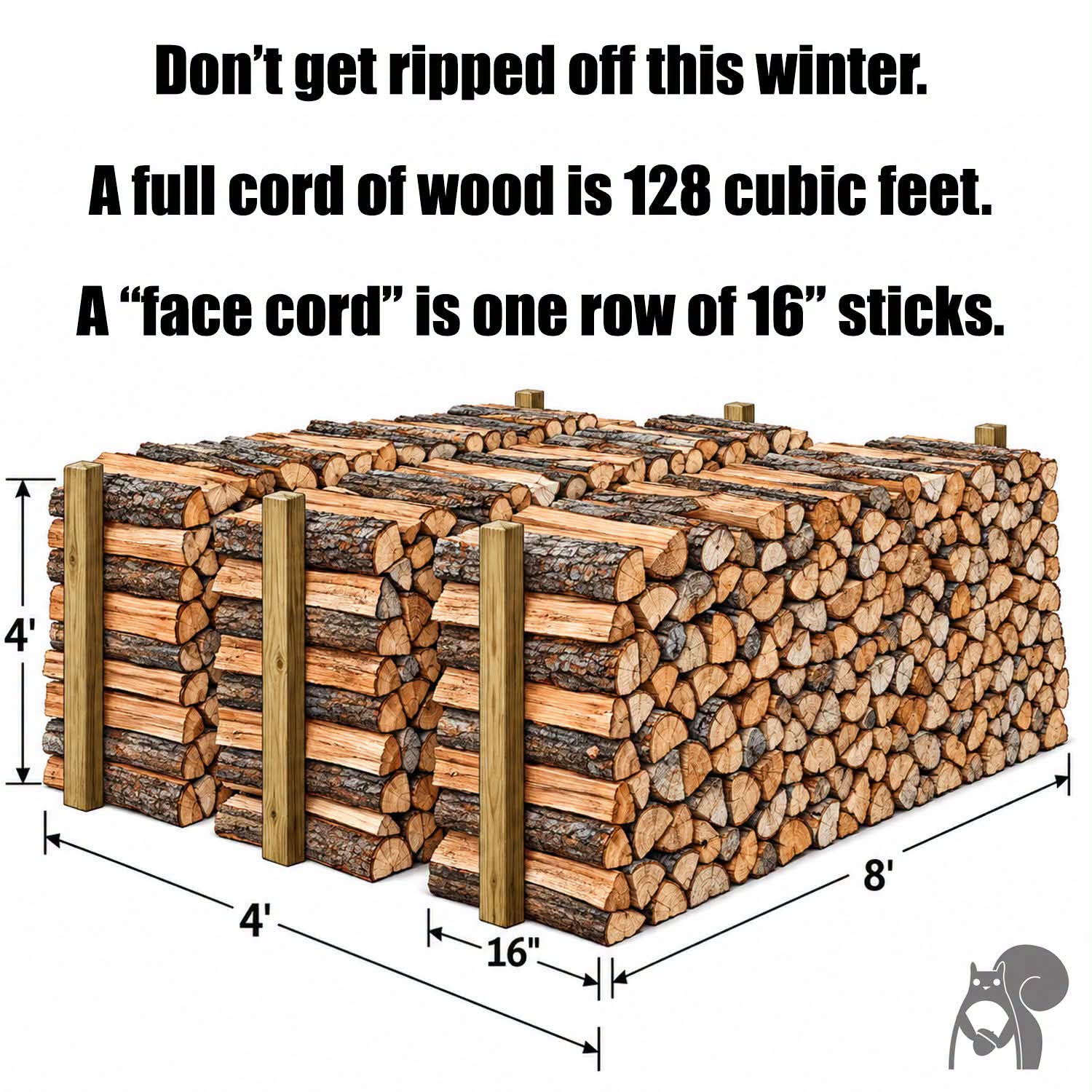
4 feet high × 4 feet deep × 8 feet long = 128 cubic feet. (Comté d’Erie)
But a cord doesn’t have to look exactly like that.
For example:
4 ft high × 2 ft deep × 16 ft long = 128 cubic feet
As long as the properly stacked dimensions equal 128 cubic feet, you’re looking at a full cord.
⚠️ The “Face Cord” Is Where Things Get Confusing
This is one of the biggest things buyers need to understand.
A face cord is generally one row of wood measuring about 4 feet high by 8 feet long, with the depth determined by the length of the individual logs.
So if the logs are 16 inches long:
4 ft × 8 ft × 16 in = about 42.7 cubic feet
That’s only about one-third of a full cord.
And if the seller uses 12-inch or 24-inch pieces, the amount of wood changes again. That’s why simply hearing “one face cord” isn’t enough to know how much wood you’re buying. (Utah State Extension)
🚨 The important question:
Don’t just ask:
“How much is a face cord?”
Ask:
“How many cubic feet or fractions of a full cord am I getting?”
That makes comparing prices much easier.
📏 Do the Math Before You Pay
Once the wood is properly stacked, measuring it is surprisingly simple.
Multiply:
Height × Width × Length = cubic feet
Then:
Cubic feet ÷ 128 = number of cords
Example:
Suppose your pile measures:
4 ft high × 8 ft long × 2 ft deep
That’s:
64 cubic feet
64 ÷ 128 = ½ cord
A pile measuring 4 × 8 × 4 feet would equal a full cord.
University extension and consumer-protection agencies recommend measuring the stacked wood rather than relying on vague descriptions such as “truckload” or “pile.” (Comté d’Erie)
🚚 Be Careful With “Truckload”
A truckload isn’t a standardized measurement.
One seller’s truckload could be dramatically different from another seller’s truckload.
Even the same truck can hold different amounts depending on how high it is loaded and how neatly the wood is stacked.
Randomly thrown wood also contains more air spaces than properly stacked wood, making the apparent volume misleading. (Comté d’Erie)
So instead of asking:
“How big is the truckload?”
Ask:
“How many cubic feet or cords are you delivering?”
That’s a much better comparison.
💧 A Full Cord of Wet Wood Isn’t the Same as a Full Cord of Good Dry Firewood
Quantity isn’t the only thing that matters.
Moisture matters enormously.
Freshly cut or poorly seasoned wood can contain a lot of water. Wet wood wastes energy evaporating that moisture instead of producing useful heat.
It can also produce more smoke and contribute to creosote buildup in a chimney. (Cornell Cooperative Extension)
For efficient burning, extension guidance commonly recommends firewood at around 20% moisture content or lower.
A moisture meter is one of the better ways to check.
Here’s the important trick:
Don’t simply test the outside of a log.
Split a piece and measure the freshly exposed interior.
The University of Maryland Extension specifically recommends splitting the wood before testing because the outside can be considerably drier than the inside. (Extension de l’Université du Maryland)
👀 Don’t Wait Until After the Truck Leaves
This is one of the biggest mistakes buyers make.
If you’re purchasing a large delivery, be there when it arrives.
Look at the wood before it disappears into a giant pile in your backyard.
Check:
- ✔️ Is it the type of wood you ordered?
- ✔️ Is it reasonably dry if advertised as seasoned?
- ✔️ Are the pieces roughly the promised length?
- ✔️ Does the quantity match what you ordered?
- ✔️ Is the load stacked or simply dumped?
- ✔️ Are there excessive gaps caused by extremely loose stacking?
- ✔️ Are you being charged for a full cord, half cord, or something else?
University of Maryland Extension recommends inspecting the load before it is unloaded when buying wood advertised as seasoned. (Extension de l’Université du Maryland)
🧾 Always Get a Receipt
A handshake isn’t enough when you’re spending serious money on heating fuel.
Your receipt should clearly state things such as:
✔️ Amount of wood
✔️ Type/species of wood
✔️ Price
✔️ Seller’s information
Exact requirements vary by location, so check your local weights-and-measures rules.
Some consumer-protection guidance also recommends recording the delivery vehicle information. (Comté d’Erie)
🌳 What Kind of Wood Are You Getting?
Not all firewood produces the same amount of heat.
Dense hardwoods generally contain more energy per unit of volume than lighter woods. Oak and hickory, for example, are commonly valued for their density and heating characteristics. (Extension WVU)
That doesn’t automatically mean one species is right for every stove or fireplace.
Your priorities may include:
- Heat output
- How easily it splits
- How quickly it seasons
- How long it burns
- Smoke production
- Spark production
- Availability and price
So if someone advertises “premium hardwood,” ask exactly what species you’re getting.
🪓 “Seasoned” Doesn’t Automatically Mean Dry
This is another important distinction.
A seller may call wood “seasoned,” but that doesn’t tell you exactly how much moisture is inside each piece.
Drying time depends on the species, how the wood was split, weather conditions and storage.
Some woods can take significantly longer to dry than others. Cornell Cooperative Extension notes that some species, including oak, can require two years or more of air drying under some conditions. (Cornell Cooperative Extension)
That’s why a moisture meter can be more useful than simply looking at the color of the wood.
💰 Compare Prices the Smart Way
Imagine Seller A says:
“$250 per face cord.”
Seller B says:
“$400 for a half cord.”
Seller C says:
“$700 per full cord.”
Those numbers are almost meaningless until you convert everything to the same unit.
Compare sellers using:
Price per full cord
Once you know the actual volume, you can make a much more useful comparison.
And don’t forget to factor in wood species and moisture content. A cheaper load of wet, low-density wood isn’t necessarily equivalent to a properly seasoned load of dense firewood.
🏡 The Best Question to Ask a Firewood Seller
Before placing your order, ask:
“How many cubic feet are in the delivery, and is that measurement based on properly stacked wood?”
Then ask:
“What species is it, and what is the approximate moisture content?”
A reputable seller should be able to clearly explain what you’re purchasing.
If the answer is simply:
“Don’t worry—it’s a big load.”
…that’s when you might want to start asking more questions. 😅
🔥 Your Winter Firewood Checklist
Before handing over your money, remember:
🪵 Quantity
Know exactly how many cubic feet or cords you’re buying.
📏 Measurement
Remember:
128 cubic feet = 1 full cord
🚚 Delivery
Don’t rely on “truckload,” “pile,” or similar vague descriptions.
💧 Moisture
If it’s advertised as seasoned, check the wood’s moisture level—ideally by splitting a sample and testing the interior.
🌳 Species
Know what kind of wood you’re actually receiving.
👀 Inspect
Be present when the delivery arrives whenever possible.
🧾 Receipt
Get the quantity, price and seller information in writing.
📐 Stack It
A properly stacked pile makes it much easier to determine what you actually received.
🏠 Don’t Pay for Air!
Firewood naturally contains air spaces when stacked—that’s part of how a cord is measured. The problem is when a loosely thrown pile is presented as though it contains the same amount of wood as a properly stacked cord.
The safest approach is simple:
Know the measurement. Know the wood. Know the moisture. Measure the delivery.
A little preparation before the truck arrives can save you from an unpleasant surprise when you’re halfway through winter and realize that your “full cord” wasn’t nearly as full as you thought.
And remember: local laws and terminology can differ, so check your area’s weights-and-measures rules before buying in bulk. (Extension du Missouri)
🔥 FINAL QUESTION:
Have you ever bought a “cord” or “truckload” of firewood and wondered if you actually got what you paid for?
Would you measure the pile yourself before paying? 🪵👀
