Does a Visible Chalaza Guarantee That an Egg Is Fresh?
Not necessarily.
This is an important distinction.
A prominent chalaza can be associated with better freshness and quality, but it should not be treated as a precise freshness test or a guarantee of food safety.
Other factors—including storage temperature, handling and the age of the egg—also matter.
The USDA recommends purchasing eggs from refrigerated cases, choosing clean and uncracked shells, and refrigerating eggs promptly.
So think of the chalaza as one clue, rather than a definitive test.
What Does a Fresh Egg Look Like?
When you crack an egg onto a plate, several characteristics can help you judge its quality.
1. A thick egg white
Fresh eggs generally have a thicker, more cohesive white that doesn’t immediately spread everywhere.
As eggs age, the white becomes thinner and spreads over a larger area.
2. A high, rounded yolk
A fresh egg usually has a yolk that stands relatively high and maintains its rounded shape.
Older eggs tend to have flatter, more fragile yolks.
3. A visible chalaza
The white, twisted strand around the yolk may be particularly noticeable in a fresh egg.
4. A clean smell
A normal egg should not have a strong unpleasant odor.
If an egg smells rotten or unusually sulfurous when cracked open, it should be discarded.
What About Cloudy Egg Whites?
Here’s another fascinating fact.
You might occasionally crack an egg and notice that the egg white looks cloudy or slightly milky.
That doesn’t necessarily mean something is wrong.
In fact, the USDA states that a cloudy egg white can be a sign that the egg is very fresh, while a clearer egg white can indicate that the egg is aging.
So an egg that looks slightly unusual isn’t necessarily a bad egg.
Should You Remove the Chalaza?
No, you don’t need to.
The chalaza is a natural and edible part of the egg.
You can leave it in when preparing:
- Fried eggs
- Scrambled eggs
- Omelets
- Boiled eggs
- Pancakes
- Cakes
- Muffins
- Cookies
- Bread
- Custards
During cooking, it usually becomes unnoticeable.
Some cooks remove it for aesthetic reasons, particularly when preparing very smooth custards or delicate desserts. But for everyday cooking, there is generally no reason to remove it.
Is the Chalaza Safe to Eat?
Yes.
The chalaza is simply a concentrated strand of egg white and is considered a normal part of the egg. USDA material describes it as a natural part of the egg that anchors the yolk.
There is no need to worry when you see it.
The important food-safety considerations are instead proper egg storage, handling and cooking.
What If the Chalaza Looks Very Large?
That’s generally not a problem.
Chalazae can vary in appearance from one egg to another. Some are thin and barely noticeable, while others are surprisingly thick and prominent.
A large or clearly visible chalaza isn’t an indication that the egg has gone bad.
In fact, the opposite can be true: a strong, prominent chalaza is consistent with an egg that has retained more of its internal quality.
What About the “Float Test”?
You’ve probably heard of placing an egg in a glass of water to determine whether it’s fresh.
An older egg can float because the air cell inside the egg becomes larger as moisture and gases escape through the shell.
However, the USDA points out that a floating egg has poorer quality, but it may still be safe to eat. The egg should be cracked into a separate bowl and checked for unusual odor or appearance before deciding whether to use it.
So the float test isn’t a perfect food-safety test.
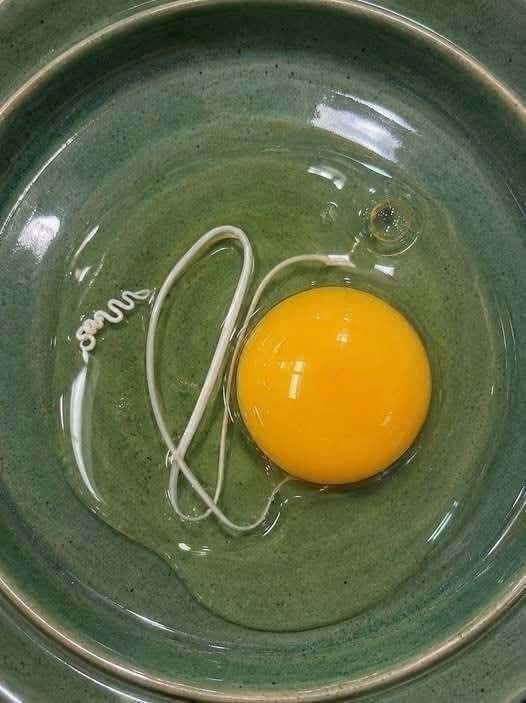
🥚 The White Strand in Your Photo Explained
The structure visible next to the yolk in the photograph is a great example of a chalaza.
You can see the bright yellow yolk surrounded by translucent egg white, with a distinct white, twisted strand running alongside it.
That strand is doing exactly what nature designed it to do:
It helps keep the yolk suspended and centered within the egg.
It may look strange when you first notice it, but there is nothing abnormal about it.
Common Myths About the Chalaza
Myth #1: “It’s a baby chicken.”
False.
The chalaza is a structural part of the egg, not an embryo.
Myth #2: “It’s a blood vessel.”
False.
The chalaza is made from concentrated egg white.
Myth #3: “It means the egg is fertilized.”
False.
Chalazae are naturally present in eggs regardless of whether fertilization occurred.
Myth #4: “You have to remove it.”
False.
It is edible and normally doesn’t need to be removed.
Myth #5: “It’s a sign that the egg is bad.”
False.
A prominent chalaza is actually associated with better retained egg quality and becomes less prominent as the egg ages.
How to Store Eggs Properly
Even a fresh-looking egg needs to be stored correctly.
According to the USDA, shell eggs should be refrigerated promptly and kept at 40°F (4.4°C) or below. Refrigerated eggs should also not be left at room temperature for extended periods.
Proper refrigeration slows the natural loss of egg quality over time.
For best results:
- Keep eggs refrigerated.
- Keep them in their original carton when possible.
- Avoid buying eggs with cracked shells.
- Don’t leave refrigerated eggs sitting out for long periods.
- Follow the storage guidance and dates provided on the packaging.
- Discard eggs with an obvious unpleasant odor or abnormal appearance.
The Important Difference Between Freshness and Safety
One of the biggest takeaways from understanding the chalaza is that egg quality and food safety aren’t exactly the same thing.
A fresh egg can still require proper handling.
Conversely, an older egg isn’t automatically spoiled simply because its chalaza has become less visible.
For food safety, storage and proper cooking are much more important than the appearance of the chalaza alone. The USDA recommends cooking eggs thoroughly, with egg dishes reaching 160°F (71°C).
Why This Tiny Detail Is So Fascinating
The chalaza is easy to overlook.
Most people crack an egg, see the yolk and white, and immediately start cooking. But that little white strand is actually an example of how precisely an egg is structured.
The egg isn’t simply a shell filled with liquid.
Inside, there are multiple specialized components working together:
Shell → protects the contents
Shell membranes → provide additional protection
Air cell → forms as the egg cools and ages
Albumen → surrounds and protects the yolk
Yolk → nutrient-rich center
Chalazae → anchor the yolk in position
Every part has a role.
Final Takeaway
The next time you crack an egg and see a strange white strand beside the yolk, don’t be alarmed and don’t automatically remove it.
You’re looking at the chalaza, a natural, edible structure made from concentrated egg white. Its job is to help anchor the yolk in the center of the egg.
And here’s the fascinating part: the more prominent the chalaza is, the more likely the egg is to have retained characteristics associated with freshness and good quality. As eggs age, the chalazae become weaker and less noticeable, while the egg white becomes thinner and the yolk becomes flatter and more fragile.
So that strange-looking white strand isn’t something to fear.
It’s not a worm. It’s not a blood vessel. It’s not a baby chick. It’s simply one of the egg’s natural support structures—and it may be giving you a small clue that your egg is still fresh. 🥚
Note: The presence or appearance of a chalaza is not a guarantee of food safety. Proper refrigeration, handling and cooking remain important.
