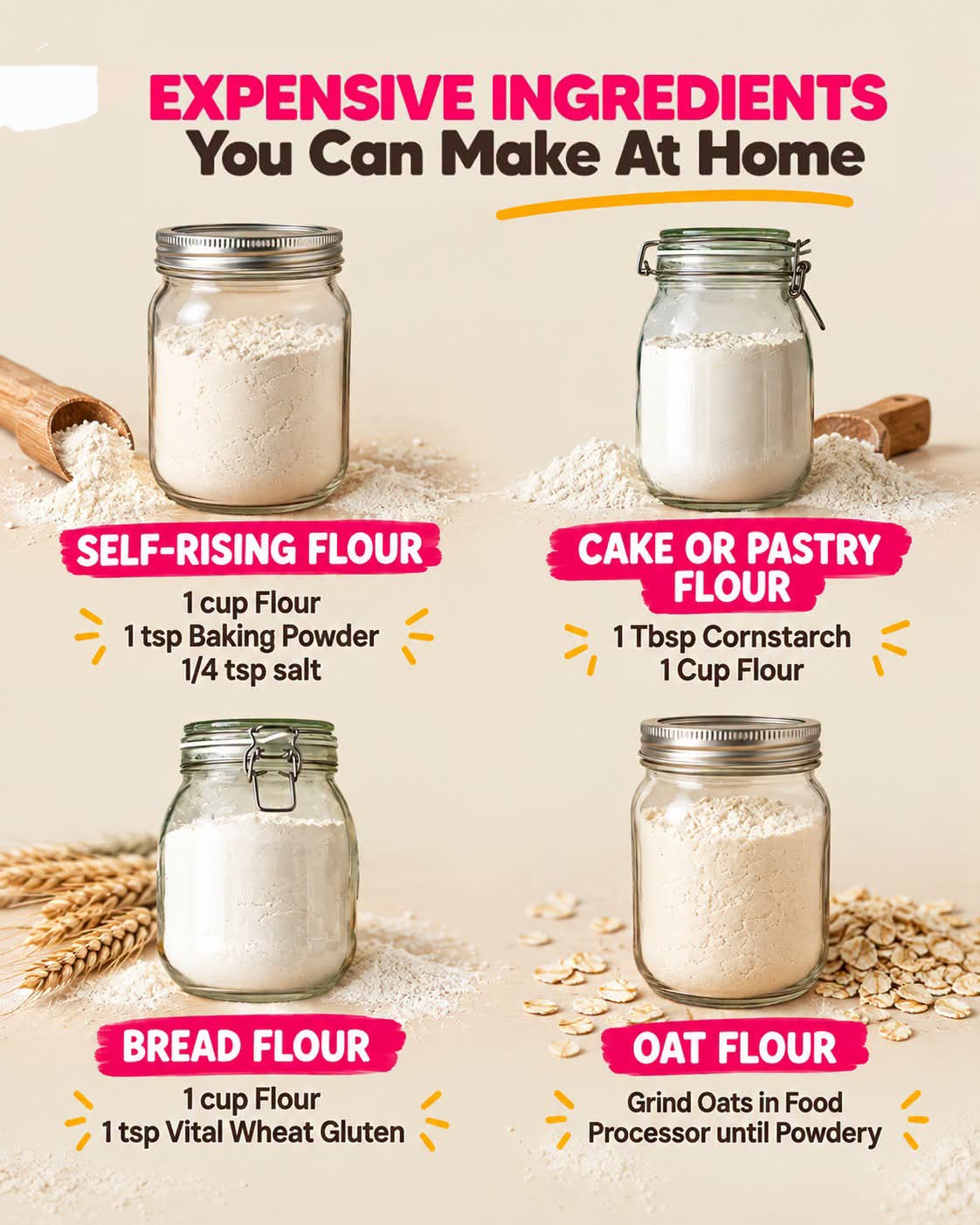
🌾✨
Have you ever reached for a recipe only to discover that it calls for self-rising flour, cake flour, bread flour, or oat flour?
Then you check the pantry… and there’s only one bag of regular all-purpose flour staring back at you. 😂
Before you make another trip to the grocery store, take a look at what you already have.
With a few simple ingredients—and sometimes nothing more than a food processor—you can make several specialty flour alternatives at home.
The important thing to remember is that homemade versions are substitutes, not always exact replicas. Different flours have different protein levels and behave differently in dough and batter. (King Arthur Baking)
Let’s break them down. 👇
🥄 1. Homemade Self-Rising Flour
Self-rising flour is one of the easiest specialty flours to recreate because it is essentially flour combined with baking powder and salt. (King Arthur Baking)
🛒 You need:
- 1 cup (120 g) all-purpose flour
- 1½ teaspoons baking powder
- ¼ teaspoon salt
👩🍳 How to make it:
- Add the flour to a bowl.
- Add the baking powder and salt.
- Whisk thoroughly until everything is evenly distributed.
- Use it in recipes calling for self-rising flour.
That’s it!
The widely used homemade formula is 1 cup flour + 1½ teaspoons baking powder + ¼ teaspoon salt. (King Arthur Baking)
🥞 Great for:
- Biscuits
- Pancakes
- Muffins
- Scones
- Quick breads
- Some cakes
Self-rising flour is particularly useful for tender baked goods because commercial versions are often made with softer, lower-protein wheat. (King Arthur Baking)
⚠️ One important tip
If you’re replacing self-rising flour in an existing recipe, remember that the baking powder and salt are already included in your homemade mixture.
Don’t accidentally add the recipe’s full amount again, or your biscuits might become a little too enthusiastic. 😂
🎂 2. Homemade Cake Flour
Cake flour is designed for delicate baked goods where you want a soft, fine, tender crumb.
Its lower protein content means less gluten-forming potential than stronger flours. (Epicurious)
And you can make a practical substitute using two pantry staples.
🛒 You need:
- All-purpose flour
- Cornstarch
👩🍳 The basic method:
For approximately 1 cup of cake-flour substitute:
- Measure 1 cup of all-purpose flour.
- Remove about 2 tablespoons of the flour.
- Replace those 2 tablespoons with 2 tablespoons cornstarch.
- Sift the mixture thoroughly.
The cornstarch helps reduce the amount of gluten-forming flour in the mixture, producing a more tender result. (Epicurious)
🎂 Great for:
- Sponge cakes
- Cupcakes
- Layer cakes
- Angel food cake
- Tender muffins
It’s particularly useful when you want a delicate crumb rather than a chewy texture.
🍞 3. Homemade Bread Flour
This one is slightly different.
Bread flour is generally higher in protein than all-purpose flour, which helps yeast breads develop stronger gluten structure and chew. (King Arthur Baking)
The graphic suggests:
🛒 You need:
- 1 cup all-purpose flour
- 1 teaspoon vital wheat gluten
Mix them thoroughly.
Vital wheat gluten increases the dough’s gluten-forming potential, making the mixture more suitable for bread recipes.
🍞 Great for:
- Sandwich bread
- Dinner rolls
- Pizza dough
- Bagels
- Chewy bread
- Some sourdough recipes
However, bread flour isn’t simply “flour with gluten added.” Commercial bread flour is milled to a particular protein specification, so a homemade blend can behave somewhat differently.
For some recipes, ordinary all-purpose flour can also substitute for bread flour, although the finished bread may be somewhat less chewy or structured. (Food Network)
🌾 4. Homemade Oat Flour
This may be the easiest one of all.
You don’t really need to “make” oat flour in the traditional sense.
You simply grind oats into a fine powder.
🛒 You need:
- Rolled oats or quick oats
- Food processor or high-powered blender
👩🍳 How to make it:
- Pour your oats into the food processor.
- Pulse several times.
- Continue processing until the oats become a fine, flour-like powder.
- Stop and scrape the sides if necessary.
- Process again until you reach the desired texture.
And that’s it! 🌾
🥣 Great for:
- Cookies
- Muffins
- Pancakes
- Quick breads
- Crumbles
- Oat-based cakes
Oat flour has a naturally pleasant, slightly nutty flavor and can add a different texture to baked goods.
💡 Why Make Specialty Flour Yourself?
There are several good reasons.
💰 Save Money
Instead of buying several different bags of flour that may sit in the pantry for months, you can start with ingredients you already have.
🏠 Save Pantry Space
Imagine having:
❌ Self-rising flour
❌ Cake flour
❌ Bread flour
❌ Oat flour
all taking up separate spaces.
Or…
one bag of all-purpose flour + a few pantry staples.
Much simpler!
🛒 Fewer Emergency Grocery Trips
We’ve all been there.
You’re halfway through a recipe when you discover:
“Wait… I need cake flour.”
Instead of abandoning the recipe, you can often make a reasonable substitute from what you already have.
🧪 But Are Homemade Versions Exactly the Same?
Not always.
This is an important point that the viral-style graphic doesn’t really explain.
Flour isn’t just “white powder.”
Different flours can have different:
- Protein levels
- Milling characteristics
- Absorption
- Gluten-forming ability
- Texture
For example, commercial bread flour is higher in protein than typical all-purpose flour, while cake flour is intentionally lower in protein. (King Arthur Baking)
So a homemade substitute can work extremely well while still producing a slightly different result.
That’s perfectly normal.
🥖 What About Pastry Flour?
The image combines cake or pastry flour as one category, but they’re not exactly the same thing.
Pastry flour generally sits somewhere between cake flour and all-purpose flour in terms of strength.
It’s useful when you want baked goods that are tender but still have enough structure to hold together.
Great for:
🥧 Pie crusts
🥐 Pastries
🍪 Cookies
🥮 Tarts
🧁 Some muffins
So if a recipe specifically calls for pastry flour, it’s worth checking the recipe’s intended texture rather than assuming cake flour and pastry flour are interchangeable.
👩🍳 A Handy Homemade Flour Cheat Sheet
| Flour | Simple homemade approach | Good for |
|---|---|---|
| 🌾 Self-rising | Flour + baking powder + salt | Biscuits, pancakes |
| 🎂 Cake flour | Flour + cornstarch | Cakes, cupcakes |
| 🍞 Bread flour | Flour + vital wheat gluten | Yeast breads, pizza |
| 🌾 Oat flour | Ground oats | Cookies, muffins, pancakes |
⚠️ A Few Baking Tips
1. Measure carefully
Baking is more sensitive to ingredient ratios than many savory dishes.
If possible, use a kitchen scale.
2. Mix thoroughly
When making self-rising flour, you don’t want all the baking powder sitting in one corner of the jar.
Whisk very well.
3. Label homemade mixtures
If you make a jar of self-rising flour, write:
SELF-RISING FLOUR — FLOUR + BAKING POWDER + SALT
Future-you will appreciate it. 😂
4. Don’t automatically substitute everything 1:1
A substitute can work beautifully in one recipe and behave differently in another.
The recipe’s other ingredients, especially liquid and leavening, matter.
5. Remember that flour can go stale
Store homemade flour mixtures in an airtight container in a cool, dry place. For longer storage, follow the storage guidance appropriate to the ingredients you’re using.
🧁 The Best Part? Your Pantry Becomes More Versatile
This is what makes homemade flour blends so useful.
A simple bag of all-purpose flour can become the starting point for several different baking projects.
Want fluffy biscuits?
Make self-rising flour. 🥐
Want a delicate cake?
Make a cake-flour substitute. 🎂
Want a stronger yeast dough?
Boost the flour with vital wheat gluten. 🍞
Have a container of oats?
Turn them into oat flour. 🌾
It’s a great reminder that you don’t necessarily need a pantry packed with specialty products to bake something delicious.
Sometimes you just need to understand what each ingredient is doing.
❤️ Final Thought
Specialty flour can sound fancy—and sometimes the price tag certainly makes it feel that way! 😂
But several varieties can be approximated at home using ordinary pantry ingredients.
The key is understanding that each flour has a purpose.
Self-rising flour brings leavening and salt.
Cake flour helps create tenderness.
Bread flour provides stronger gluten structure.
Oat flour brings the flavor and texture of ground oats.
Once you understand those differences, baking becomes a little less intimidating—and your pantry becomes a lot more useful. 👩🍳✨
👀 Which one would you make first?
Self-rising flour 🥐
Cake flour 🎂
Bread flour 🍞
or Oat flour 🌾?
And the real question…
How many of these have you been buying when you could have made them at home? 😂
