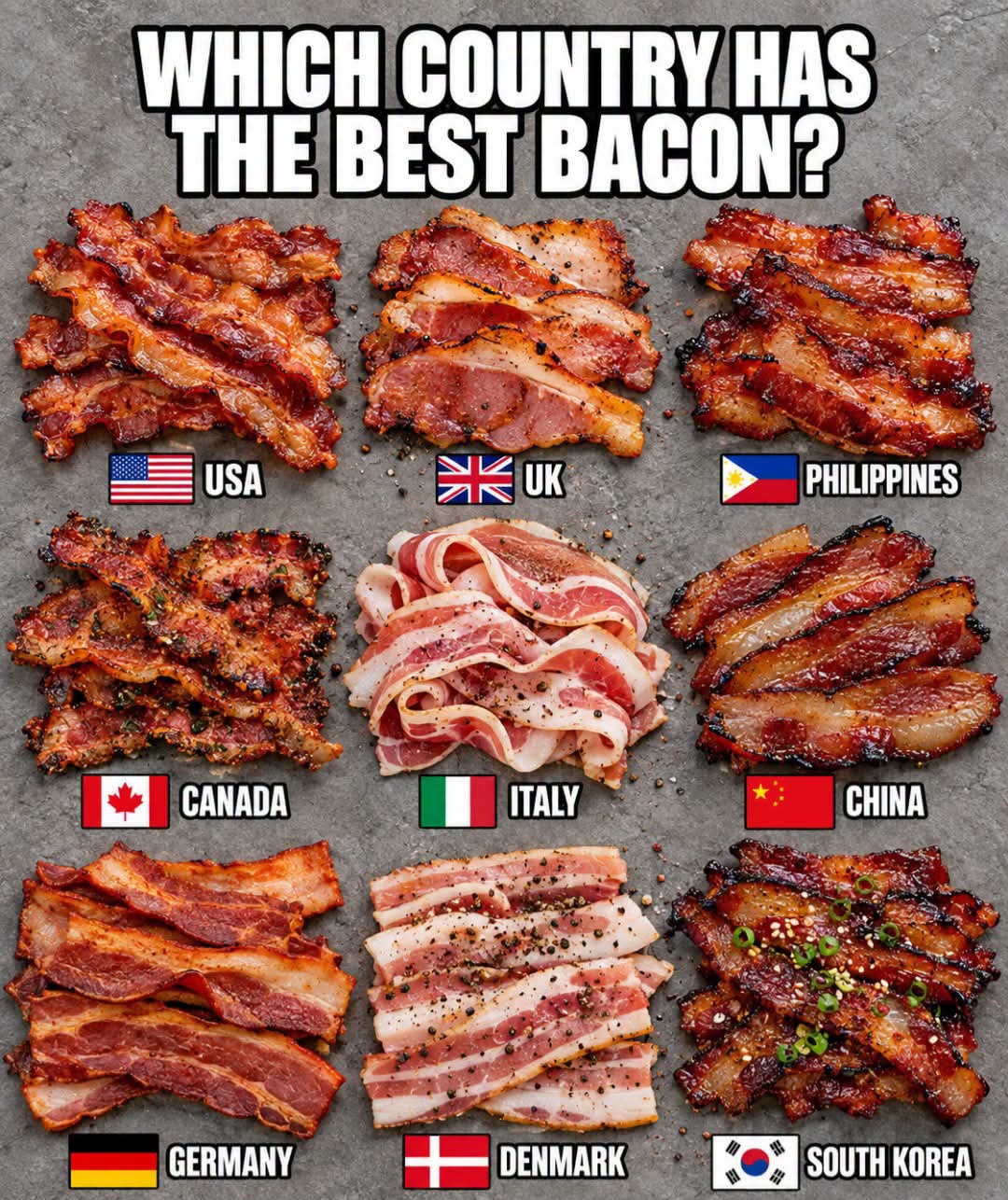
🥓👀
A Delicious Look at Bacon Styles From Around the World
Bacon may seem like a simple breakfast food, but take a look around the world and you’ll quickly discover that “bacon” can mean very different things depending on where you are.
Some versions are thin and crispy. Others are thick and meaty. Some are smoked, some are simply cured, and others are seasoned with sugar, spices, or herbs.
The image above puts nine different bacon styles side by side and asks the question:
Which one are you going for? 🥓
Let’s take a delicious trip around the world!
🇺🇸 USA — Classic Streaky Bacon
For many Americans, this is the bacon.
American-style bacon is typically made from pork belly, giving it those familiar alternating streaks of meat and fat. It’s commonly cured and smoked, then sliced and cooked until crisp. (fsis.usda.gov)
This is the bacon you’ll find beside:
- Scrambled eggs
- Pancakes
- French toast
- Breakfast sandwiches
- Burgers
- BLTs
- Baked potatoes
And let’s be honest—the smell of bacon cooking in the morning is hard to beat.
🇬🇧 UK — Back Bacon
British bacon looks noticeably different from the typical American strip.
Traditional British back bacon comes primarily from the loin, often with a portion of belly attached. That makes it meatier and generally less fatty than American streaky bacon. (Food Network UK)
It’s a familiar component of a full English breakfast, alongside eggs, sausage, beans, tomatoes, mushrooms, and toast.
If you prefer your bacon substantial and meaty rather than extremely crispy, this may be your style.
🇵🇭 Philippines — Sweet & Savory Tocino
Now we’re getting into a completely different flavor profile.
Filipino tocino is sweet-cured pork traditionally seasoned with ingredients such as sugar and salt, with regional recipes adding other flavors. It’s often cooked until caramelized and browned. (Tatler Asia)
Instead of expecting smoky and salty bacon, imagine something with a sweet, savory, caramelized personality.
Tocino is commonly enjoyed as part of breakfast dishes, particularly with rice and eggs.
🇨🇦 Canada — Peameal Bacon
Canadian bacon can cause a little confusion because the term means different things depending on where you are.
One particularly Canadian style is peameal bacon, which is made from cured pork loin and traditionally rolled in cornmeal. (Food Network UK)
It’s much leaner than American belly bacon and has a firm, meaty texture.
It’s especially associated with Toronto, where peameal bacon sandwiches are a well-known specialty.
🇮🇹 Italy — Pancetta
Italian bacon takes a different approach.
Pancetta is cured pork belly and is generally not smoked, allowing the flavor of the pork, salt, herbs, and spices to come through. It can be sold flat or rolled and is frequently diced or sliced for cooking. (fsis.usda.gov)
Pancetta is often used as an ingredient rather than simply served as a pile of crispy breakfast strips.
It’s wonderful in:
- Pasta dishes
- Soups
- Risotto
- Vegetables
- Sauces
- Egg dishes
And then there’s guanciale, made from cured pork jowl, which is another important Italian cured pork product. (Epicurious)
🇨🇳 China — Cured Pork Belly & Regional Bacon Traditions
Chinese cured pork products can look quite different from Western breakfast bacon.
One example is lap yuk, a Cantonese-style cured pork product traditionally preserved with salt and used in dishes involving rice and other ingredients. (bar-s.com)
Rather than automatically frying it into crispy strips for breakfast, Chinese cured pork is often used to add intense savory flavor to larger dishes.
It’s a great example of how the same basic idea—curing pork to preserve it and concentrate its flavor—can develop into a completely different culinary tradition.
🇩🇪 Germany — Speck
German speck brings another variation to the table.
Speck generally refers to cured pork that may be smoked and aged, and different regional traditions produce different styles.
Some versions are used in cooking, where small pieces can be browned to release their flavorful fat.
Think hearty dishes, potatoes, eggs, vegetables, soups, and stews.
If you like bacon with a pronounced cured and smoky character, German-style speck is definitely worth exploring. (fsis.usda.gov)
🇩🇰 Denmark — Danish Bacon
Denmark has a long association with bacon production, particularly through its historic export trade with Britain. (Wikipédia)
Danish bacon is commonly associated with cured pork produced for the breakfast and food markets, and Denmark remains strongly connected with the European bacon industry.
It’s another example of how bacon isn’t simply one universal product—the cut, curing process, smoking, thickness, and cooking method can all change the experience.
🇰🇷 South Korea — Samgyeopsal
Here’s one of the most interesting entries on the list.
Samgyeopsal refers to thick slices of pork belly commonly grilled Korean barbecue-style.
Technically, it’s not the same thing as traditional cured bacon. It’s fresh pork belly rather than the cured and smoked pork belly typically called bacon in the United States. (Fox News)
But visually, those beautiful layers of meat and fat definitely make it understandable why people include it in global “bacon” comparisons.
It’s commonly cooked at the table and enjoyed with sauces, vegetables, and other accompaniments.
Why Does Bacon Look So Different Around the World?
It all comes down to several factors.
🐖 The Cut
Bacon can come from different parts of the pig.
American streaky bacon typically comes from the belly, while British back bacon is primarily from the loin. Pancetta comes from the belly, while guanciale comes from the jowl. (fsis.usda.gov)
🧂 The Cure
Curing traditionally uses salt and other ingredients to preserve meat and develop flavor.
Modern bacon production can involve either wet curing or dry curing. (fsis.usda.gov)
🌫️ Smoking
Not every bacon-style product is smoked.
Some traditions rely heavily on smoke, while others emphasize salt, herbs, spices, sugar, or the natural flavor of the pork. (fsis.usda.gov)
🔥 The Cooking Method
How you cook it can completely change the final texture.
Pan-fried until crisp?
Oven-baked?
Grilled?
Rendered slowly?
Caramelized?
Or cooked as part of another dish?
There’s no shortage of possibilities.
What’s Your Bacon Personality? 🥓
Maybe you’re a crispy bacon person who wants every strip to practically shatter when you bite into it.
Maybe you prefer bacon that’s chewy and meaty.
Maybe you love the sweet caramelized flavor of Filipino tocino.
Maybe Italian pancetta is more your style.
Or perhaps Korean pork belly has completely changed your idea of what bacon should be.
And that’s what makes this comparison so much fun.
🥓 Let’s Settle It in the Comments!
If you could choose ONE of the nine pictured styles for your next breakfast, which one would you grab?
🇺🇸 USA
🇬🇧 UK
🇵🇭 Philippines
🇨🇦 Canada
🇮🇹 Italy
🇨🇳 China
🇩🇪 Germany
🇩🇰 Denmark
🇰🇷 South Korea
Which bacon are you going for? 👀🥓
And here’s the real question:
Do you like your bacon crispy, chewy, thick-cut, smoky, sweet, or somewhere in between?
Because apparently, there is a whole world of bacon out there—and we may have been limiting ourselves to one skillet this entire time. 😂
Note: The image uses “bacon” broadly. Some of the foods shown, such as Korean samgyeopsal, are not technically cured bacon in the traditional sense. They are included because they represent comparable pork-belly traditions and are commonly featured in global bacon comparisons. (fsis.usda.gov)
