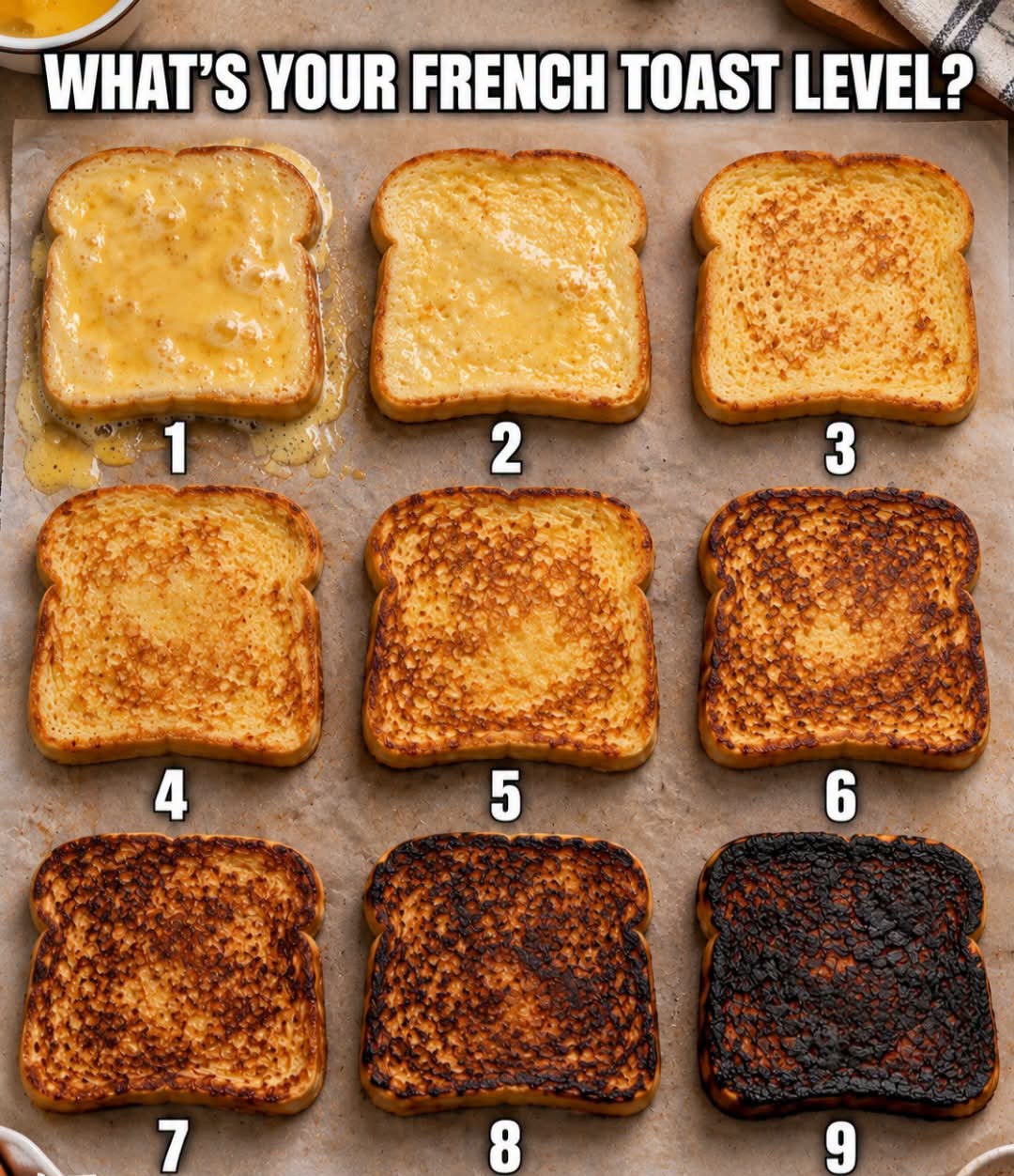
What’s Your French Toast Level? 🍞🥚🥞
French toast is one of those breakfasts that can be as simple—or as adventurous—as you want it to be.
A few slices of bread, eggs, milk, cinnamon, and a little vanilla can turn into something wonderfully crisp on the outside and soft and custardy in the middle. (Eat Right)
But this photo asks a very important question:
What’s your French toast level? 👀
From Level 1, where the bread is practically swimming in custard, all the way to Level 9, where it has been taken very far into charred territory, there seems to be a French toast preference for everyone.
And honestly… some people are going to look at #5 and say “PERFECT!” while someone else is going straight for #2.
So let’s break them down!
🍞 Level 1 — The Extra-Soaked
This is for the person who believes French toast should be loaded with eggy custard.
The bread is thoroughly coated, soft, rich, and almost pudding-like.
The key is knowing the difference between custardy and soggy. Bread can absorb quite a bit of the egg mixture, but leaving it submerged too long can make it difficult to handle.
🍞 Level 2 — Soft & Tender
This one is still pale and soft, with plenty of custard absorbed into the bread.
If you prefer French toast that’s more about the soft interior than a crunchy crust, this may be your level.
A gentle cooking temperature helps the center set without scorching the outside.
🍞 Level 3 — Lightly Golden
Now we’re getting into classic French toast territory.
The surface has developed a beautiful golden color while the inside can remain tender and moist.
This is the kind of French toast that works beautifully with a little butter and maple syrup.
🍞 Level 4 — Golden & Toasty
For many people, this is the sweet spot.
The outside has more color and texture, while the center remains soft.
French toast is generally cooked over medium heat until golden brown; several tested recipes recommend cooking roughly a couple of minutes per side, with timing adjusted for the bread and pan. (Eat Right)
🍞 Level 5 — Deep Golden Brown
Now we’re talking!
This version has a noticeably crisp, caramelized-looking surface while still retaining some tenderness inside.
If you like crispy edges + soft middle, this is probably where you start getting excited.
🍞 Level 6 — Seriously Toasted
We’re getting into extra-crispy territory.
The darker surface brings a stronger toasted flavor, and the texture is much more pronounced.
The trick here is controlling the heat. Too much heat can brown the exterior before the egg mixture in the center has properly cooked.
🍞 Level 7 — Very Dark & Crispy
This is where French toast becomes a little controversial.
Some people love deeply browned food because of the intense toasted flavor and crunchy texture.
Others will look at this slice and immediately reach for the maple syrup bottle!
🍞 Level 8 — Extra Toasted
We’re officially in “I like my French toast DARK” territory.
There’s still some golden color visible, but the surface is heavily browned.
If this is your favorite, you’re probably not asking for lightly toasted French toast at a restaurant.
You’re asking for CRISPY.
🍞 Level 9 — Charred
And then there’s #9.
This one has gone well beyond ordinary golden-brown French toast and into heavily blackened territory.
For everyday cooking, burning isn’t the goal. If your French toast starts turning black before the center is cooked, lower the heat and give it more time.
How to Make French Toast at Home
If you’re trying to find your perfect level, start with a basic recipe and adjust the cooking time and temperature.
Ingredients
- 6 slices bread
- 2 large eggs
- 1/2 cup milk
- 1 teaspoon vanilla extract
- 1/2 teaspoon ground cinnamon
- 1 tablespoon sugar, optional
- Pinch of salt
- 1–2 tablespoons butter, for cooking
- Maple syrup, for serving
For especially rich French toast, thick slices of brioche, challah, or similar bread work beautifully. Slightly stale bread is also useful because it can absorb the custard without becoming as fragile as very fresh bread. (Extension | University of New Hampshire)
Instructions
1. Make the custard.
In a shallow bowl or baking dish, whisk together the eggs, milk, vanilla, cinnamon, sugar, and salt until completely combined.
You don’t want visible streaks of egg white remaining. (Food Network)
2. Heat the pan.
Place a skillet or griddle over medium heat and add the butter.
You want the pan hot enough to brown the bread but not so hot that the outside burns before the center cooks.
3. Dip the bread.
Place one slice into the egg mixture and coat both sides.
Don’t leave thin sandwich bread sitting in the custard for too long. Thicker or drier bread can generally handle a longer soak. (Food Network)
4. Cook.
Transfer the bread to the hot skillet.
Cook until the bottom reaches your preferred level of golden brown, then carefully flip.
Continue cooking until the second side is done and the custard has set.
5. Serve immediately.
Transfer to a plate and top with butter, maple syrup, powdered sugar, fresh berries, bananas, or whatever makes your breakfast happy.
The Secret to Better French Toast
Don’t use bread that’s too fresh and soft.
Slightly stale bread has less surface moisture and can absorb the custard without immediately falling apart. (Extension | University of New Hampshire)
Don’t oversoak thin bread.
A short dip is usually enough for ordinary sandwich bread. Thick slices can take more time.
Keep the heat moderate.
Medium heat gives the center time to cook while the exterior develops that beautiful golden crust.
Whisk the eggs thoroughly.
You want the egg and milk mixture evenly distributed throughout the custard. (Food Network)
Cook in batches if necessary.
Crowding the pan can make it harder to brown the bread evenly.
And Now for the Important Question… 👀
Forget the recipe for a second.
Which French toast are YOU choosing?
🥚 1 — Soaked & custardy
🤍 2 — Soft & tender
🌤️ 3 — Lightly golden
🍞 4 — Golden & toasty
✨ 5 — Deep golden brown
🔥 6 — Seriously toasted
🔥 7 — Very dark
🖤 8 — Extra toasted
💀 9 — Charred
Personally, the fun of this picture is that there really isn’t one universal answer. French toast is all about texture and preference.
Some people want that soft, custardy center.
Some want crisp, buttery edges.
Some want the whole slice golden brown.
And some apparently aren’t stopping until the smoke alarm gets involved. 😂
So… what’s your French toast level? 👇
Drop your number in the comments: 1–9!
And be honest…
Are you a #3, a #5, or are you proudly living at #9? 🍞🔥
